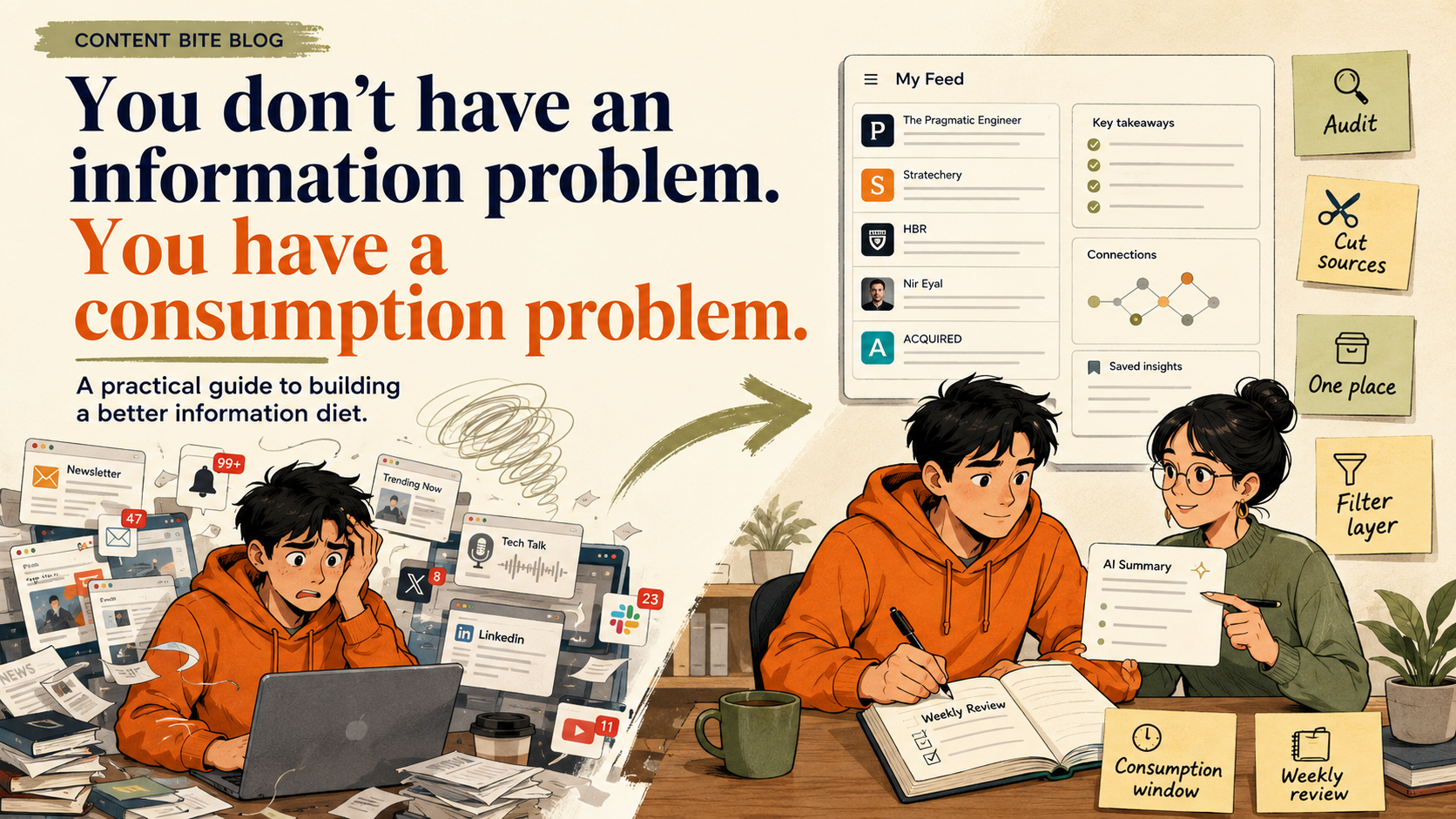
You don't have an information problem. You have a consumption problem.
There's more valuable news, analysis, and ideas available today than at any point in human history. The problem is that the systems most people use to access that information are optimized for engagement not understanding. For time-on-app not retention.
The result: professionals who spend hours a day consuming content and still feel behind.
If that sounds familiar, this guide is for you.
What is an information diet?
The term was popularized by Clay Johnson's 2012 book The Information Diet, but the idea is simple: just as you can be malnourished on junk food while eating constantly, you can be intellectually malnourished while consuming content constantly.
A good information diet means:
Intentionally choosing what you consume
Prioritizing depth over volume
Knowing when you're full
In 2026, with AI-generated content flooding every platform, this matters more than ever.
Step 1: Audit what you're actually consuming
Before changing anything, spend one week tracking where you get your information:
Which apps do you open? In what order?
How long do you spend on each?
What do you actually remember 24 hours later?
Most people are shocked by two things: how much time they spend, and how little they retain. Track it for just three days, the pattern becomes obvious.
Step 2: Cut your sources in half
Most people follow too many sources. More sources doesn't mean more information. It means more noise.
The goal isn't to read everything. The goal is to read the right things deeply.
Start with a simple rule: you can only follow sources you would actively seek out, not passively tolerate. If you wouldn't pay $1/month for it, unsubscribe.
For most professionals, 5–8 high-quality sources cover everything that matters.
Step 3: Consolidate your consumption into one place
The biggest hidden cost of a scattered information diet is context switching.
Every time you move between apps — from your email newsletter to Twitter to a news app — you pay a cognitive toll. You lose the thread. You forget what you were looking for. You get distracted by something adjacent.
The fix: one inbox for all your information.
Whether it's an RSS reader, a dedicated app, or a curated newsletter the format matters less than the consolidation. Stop letting information live in 6 different places and demand your attention from 6 different directions.
Step 4: Add a filter layer
Raw headlines are designed to create anxiety. The headline "Markets tumble on inflation fears" and "Markets rise on strong jobs data" can appear on the same day. Individually they create noise. In context they're meaningless.
What you need is a filter layer: something that helps you decide in seconds whether a piece of content deserves your full attention.
This is where AI summaries are genuinely useful. Not to replace reading, but to triage it. A 2-sentence summary of an article helps you decide: is this worth 5 minutes of my attention, or can I move on?
Used correctly, AI summaries help you read more of what matters and none of what doesn't.
Step 5: Define a consumption window
One of the most effective changes you can make: stop reading the news reactively.
Instead of opening a news app whenever you have a spare moment, define when you consume information:
15 minutes in the morning, after coffee, before email
10 minutes after lunch
Never after 8pm
The specific times don't matter. The intention does.
When you consume on a schedule, you're in control. When you consume reactively, the algorithm is.
Step 6: Review what you actually consumed
This is the step most people skip, and it's the most powerful.
Once a week, look at what you actually read, watched, and listened to. Not what showed up in your feed. What you engaged with.
This feedback loop does two things:
It shows you what kinds of content actually hold your attention (revealing what you care about vs. what you think you care about)
It keeps you accountable to your stated information priorities
If your stated priority is "staying sharp on industry trends" but your consumption review shows you mostly read celebrity news and political outrage — that's information worth having about yourself.
What a good information diet looks like in practice
A professional with a well-designed information diet might look like this:
Morning (10 min): Scan a curated feed of 5–6 trusted sources. Read 2–3 articles fully. Skip the rest.
Lunch (10 min): One podcast episode on a commute or walk. Something in their industry.
Evening (0 min): Nothing. The news will be there tomorrow.
Weekly (5 min): Review what they consumed. Adjust sources if something's not adding value.
That's 20–25 intentional minutes per day, replacing 2–3 hours of scattered, reactive consumption.
The tool I built for this
After years of struggling with this myself, I built , a personalized news and media digest that consolidates your sources, surfaces AI summaries, and sends you a weekly review of what you actually consumed.
It's free to start. And it's the system I now use every day.
But honestly, even without a tool, the steps above will change your relationship with information. Start with the audit. Everything else follows.
The point
You don't need to be less curious. You don't need to care less about what's happening in the world.
You just need a better system for staying informed one that works for you, not against you.
An information diet isn't about consuming less. It's about consuming intentionally.
Start your information diet today — try Content Bite free at getcontentbite.com