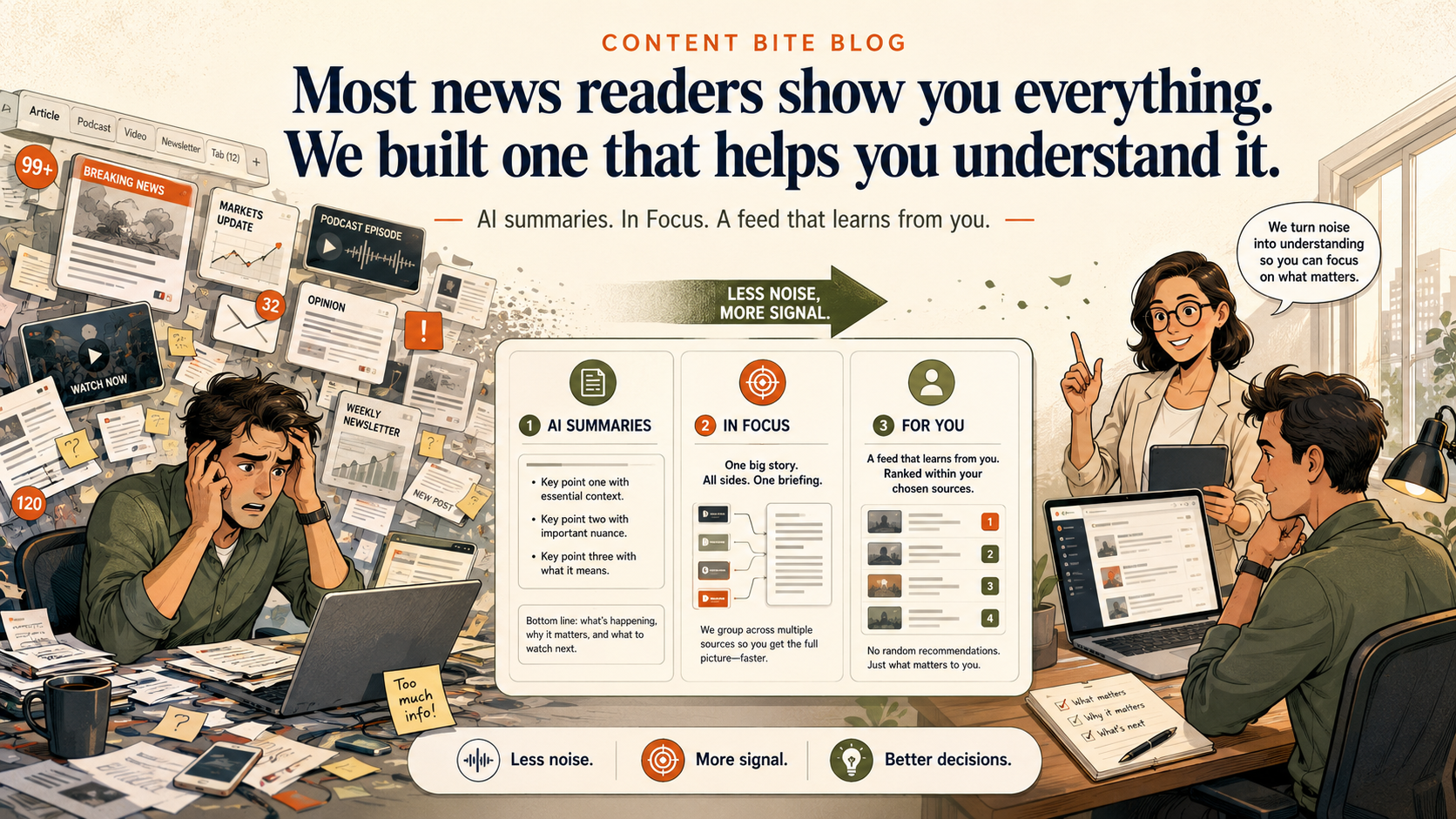
Most news readers show you everything. We built one that helps you understand it.
There's a paradox at the center of how most people consume news today.
We have access to more information than any generation in history — thousands of publications, hundreds of podcasts, endless YouTube channels covering every corner of the world. And yet most people feel less informed, not more. The volume is the problem. There's no layer between "firehose" and "understanding."
RSS readers solve the subscription problem. They don't solve the comprehension problem.
That's what we set out to fix with Content Bite.
The AI layer we built — and why
Content Bite started as a personal project. I was juggling Feedly for articles, a separate podcast app, YouTube subscriptions, and three different newsletters — switching between them dozens of times a day, never feeling like I had the full picture on anything.
The question I kept asking: what if there was one place that not only aggregated everything, but actually helped me make sense of it?
Modern LLMs made that question answerable. Here's what we built.
Feature 1: AI summaries that actually summarize
Every article in Content Bite gets processed by Claude — Anthropic's language model — and turned into a structured summary before you ever open it.
Not a truncation. Not the first two paragraphs. A genuine read of the piece, condensed into:
Three bullet points covering the core facts, the most important context, and the implication or reaction
A short closing paragraph — two sentences, neutral tone, that ties it together
The goal is that you can read the summary in 20 seconds and decide whether the full article is worth 5 minutes of your time. For most articles, it isn't — and that's fine. The summary did its job.
The RTL rabbit hole
One part of this took far longer than expected: making summaries work correctly across right-to-left languages like Arabic, Hebrew, and Farsi.
It sounds simple. It isn't. LLMs like Claude occasionally inject invisible Unicode bidirectional control characters into their output — characters you can't see in the text but that browsers and rendering engines respond to. In practice, this meant bullet points showing up on the wrong side, text direction flipping mid-sentence, and summaries that looked fine in English but were visually broken in Arabic.
The fix involved two layers: stripping bidi control characters from every LLM response server-side before storage, and fixing a subtle bug in our direction-detection regex where a decomposed Hebrew character was creating an unintended 60,000-codepoint range that matched the bullet character itself.
It's fixed now. Arabic summaries render correctly. The bullet dots are on the right side. It took a week.
We mention this not to complain, but because it reflects something we believe: multilingual support isn't a feature you bolt on later. We built it in from the start because the audiences who read Arabic, Persian, and Hebrew news deserve the same experience as everyone else.
Feature 2: In Focus — when multiple sources cover the same story
This is the feature we're most proud of.
Here's the problem it solves: when something big happens — a major trade deal, a scientific breakthrough, a geopolitical shift — it gets covered by dozens of outlets simultaneously. Each article has a slightly different angle, a different source, a different emphasis. If you only read one, you get one perspective. If you try to read all of them, you spend an hour on a single story.
In Focus does something different. Every 6 hours, an automated pipeline:
Fetches recent articles from 50 curated sources across 10 categories — World News, Politics, Business, Technology, Science, Health, Sports, Culture, Environment, and Dev & Engineering
Sends every headline to Claude with a single question: which stories are being covered by 3 or more different sources right now?
For each qualifying story cluster, generates a single merged summary drawing from all sources combined
Stores the results so the tab opens instantly — no waiting, no real-time API calls
The result is a feed that answers a question no other news product answers cleanly: what's actually big today?
Not "what's trending on one platform." Not "what got the most clicks." What multiple independent newsrooms, across different categories and editorial perspectives, all decided was worth covering at the same time.
If Al Jazeera, ESPN, and The Guardian independently cover the same story, that story surfaces in In Focus with a unified briefing at the top. You get the full picture in one read.
Feature 3: A "For You" feed that learns from you — not despite you
Algorithmic recommendation is a solved problem in the worst possible way. TikTok, YouTube, and Twitter/X have all optimized their algorithms to maximize engagement — which in practice means maximizing the content most likely to provoke a reaction, not the content most likely to inform.
We took a different approach.
Content Bite's For You feed is personalized, but bounded. The algorithm works only within the sources you chose to follow. It learns your preferences — which topics you read in full, which sources you return to, what you like and save — and uses that to rank your existing subscriptions more intelligently.
There are no recommendations from sources you never asked for. No black-box decisions about what you "should" be interested in. The AI is a ranking assistant, not an editorial director.
The more you use it, the better it gets at distinguishing between "I follow this source but only for certain topics" and "I want everything from this source." That signal compounds over time into a feed that genuinely reflects how you read, not how an algorithm wants you to read.
What we're building toward
These three features — AI summaries, cross-source story grouping, and behavior-based personalization — are the foundation of what we think a modern news reader should be.
There's more coming. We want to expand In Focus to cover your personal sources, not just our curated set. We're working on a mobile app. And we're thinking carefully about how to bring the AI layer deeper into the reading experience — not just before you open an article, but while you're inside it.
But the core philosophy won't change: the AI's job is to give you more signal, not more content. Less noise. Fewer tabs. A clearer picture of what's happening in the world.
If that sounds like something you'd use, Content Bite is free to try at getcontentbite.com. No credit card required. Bring your RSS feeds, your podcast subscriptions, your YouTube channels — and let's see if we can make sense of it all together.
cContent Bite is an AI-powered news reader that unifies your RSS feeds, podcasts, and YouTube subscriptions into one personalized, summarized feed.